You can see her right away at the salon after lunch. She twists the ends of her bob with her fingers while looking in the mirror, which makes her look flatter and flatter as time goes on. Her hair is clean and shiny, but it is flat against her face. The stylist picks up a piece and drops it, and the whole style falls apart like a cake that didn’t rise. They both laugh, but her eyes look sad. She takes out her phone and shows a picture of a person with short, bouncy, full hair that is clearly longer than hers. She says she just wants it to look thicker, which is what she’s said at every appointment for the last five years. The stylist smiles, picks up the scissors, and suggests a new look. After three quick cuts, the hair looks like it’s alive. It’s hard to say what changed, but it did. The secret isn’t having more hair. It’s all about finding the best short haircut for thin hair.
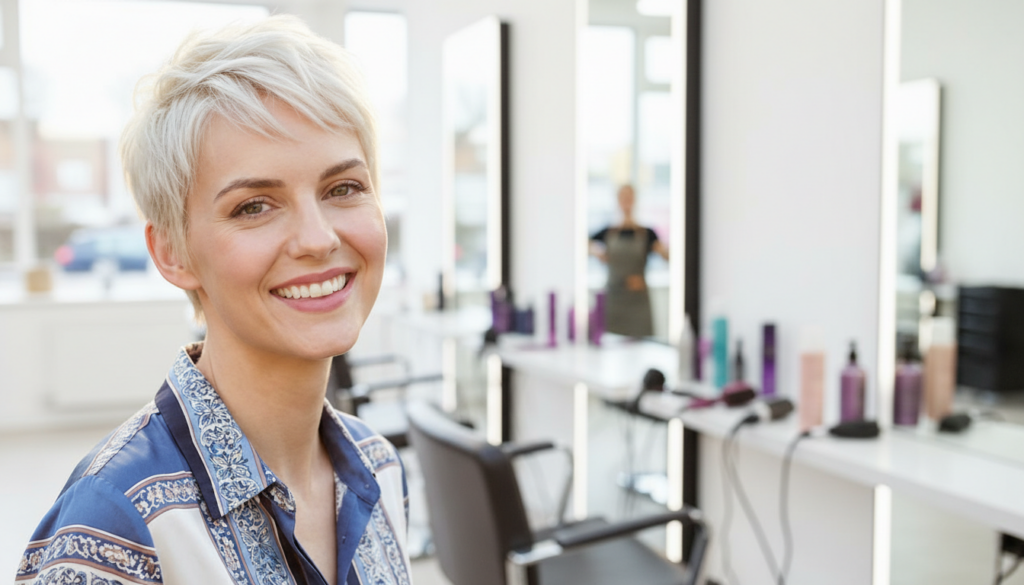
Fine Hair Short Haircuts
Short fine hair explained: why some haircuts make hair look flat and others make it look thicker. Fine hair is soft, light, and easy to lose its shape, just like silk thread. When the cut is wrong, strands stick to the scalp, especially around the crown and jawline. That’s how the “helmet” look happens: the roots are flat, the hair doesn’t move, and it feels thinner than it really is.
Beauty experts and top consumer reviews say that the best lip liners for all-day wear are the ones that give you precise definition. When it comes to short styles, placement is very important. Fine strands can look even more limp if they’re too long. A blunt bob that goes to the jaw and has no layers, for instance, tends to stick to the face. The real secret is to use the right length, layer smartly, and lose weight slowly. That’s when volume starts to show up on its own.
Henna blends that are safe and give you rich, long-lasting colour. On a Tuesday afternoon in London, stylist Maya R. showed this off perfectly. A client came in with a long bob that was too long and hadn’t been cut in nine months. The ends looked uneven, and the roots looked greasy just a few hours after washing. The hair didn’t hurt; it was just very thin.
Shortcuts that make your hair look thicker work by moving the weight around. It flattens the shape and takes away extra bulk, and it adds softness to help lift the crown and face. The strands don’t clump together because of the airy layers, undercut napes, and slightly uneven edges. The end result is hair that looks thicker but doesn’t really grow.
Four great short haircuts that make thin hair look thicker
The bixie haircut is the first option that stands out. This pixie-bob mix is great for fine hair because it keeps the length around the face soft while making the back and sides closer to the head. This difference makes the picture look three-dimensional right away. The subtle crown layers keep the hair from lying flat in one sheet. A little bit of texturising cream makes each strand stand out and reflect light, which makes it look thicker. It also grows out nicely, which makes it useful for people who don’t go to the salon very often.
The modern French bob is the second most popular style. Not the heavy, perfectly blunt version, but a softer, slightly broken cut that goes between the lip and jaw. The ends are spread out, but the layers inside are still hidden. On days when you don’t have to do much, it fits perfectly behind your ears. On better days, a quick upside-down rough-dry gives you that easy Parisian look. For many people with fine hair, this is the first style that finally makes flat roots less of a problem every day.
The soft layered pixie comes in third. This isn’t a very short, sharp style; it’s a feathered shape that moves. The sides and back are tapered to give the shape a clean look, while the top stays longer to give you more freedom. Fine hair does better here because there isn’t as much weight pulling down. A little mousse at the roots and a quick blast from the dryer usually do the trick. It’s especially freeing for people who have been hiding behind longer, lifeless lengths for years.
The stacked nape bob is the fourth reliable choice. The back is shorter and graduated, and the front is longer and angled toward the chin. It makes a soft diagonal when you look at it from the side. When you look at it from the back, the stacked layers make a soft curve. This structure adds volume right to the shape. The stacking lifts hair at the back of the head, which keeps the shape full. It looks sleek when worn straight. With waves and a little sea salt spray, it can look like there is twice as much hair.
Main point
| Information | Why it matters to people who read it |
|---|---|
| The best cut for very fine, flat hair | A soft layered pixie or bixie with longer hair on top and lighter hair on the sides. |
| The best products for styling | Put some light mousse on the roots, some sea salt or texturising spray on the mid-lengths, and some dry shampoo on day two. |
| How often to cut | Every 6 to 8 weeks for a bob or stacked bob, and every 4 to 6 weeks for a pixie or bixie. |
| How to style short, fine hair so that it stays full of volume | Start by drying your hair roughly with your head upside down until it is about 80% dry. Instead of a brush, use your fingers to lift at the crown. |
In real life, people often rush to style their hair. On a Monday morning in a busy coworking bathroom, a woman with a new French bob had just five minutes and a travel straightener. What worked wasn’t perfect.
 Goodbye Hair Dye for Grey Hair: The Simple Conditioner Add-In That Restores Natural Colour Gradually
She lightly dampened the front pieces, lifted the roots with her fingers, and used warm air to set them. The back stayed imperfect, but the style looked like it was meant to be that way. Practical styling is better than perfect routines.
In reality, no one styles perfectly every day. That’s why habits on day two are important. Putting on a thin layer of dry shampoo at night helps soak up oil before it builds up. If you sleep with your part on the other side, it will keep your roots lifted until morning.
Never rub hair; instead, gently blot it with a microfibre towel or cotton T-shirt. Use styling products only on the ends and mid-lengths of your hair. Spray or mousse on the scalp only a little bit.
Having short, fine hair: self-assurance, trying new things, and ease
Choosing short hair with fine strands is often more than just a style choice. It can feel like a quiet protest against years of ponytails that never looked full enough. When you cut it short, you often have to stop comparing.
On one train ride home, a woman in her forties ran her fingers through her stacked bob and said, “I finally stopped waiting for my hair to be something it isn’t.” That moment meant more than any product suggestion ever could.
When a cut shows your neck, jawline, and cheekbones, it feels different. Short hair on fine texture often gives you that feeling of freedom that is both familiar and new.
It doesn’t always go smoothly. There are weeks when the fringe won’t work, or the humidity takes over. Some mornings you let the air dry and accept the softness, while other days you work on every bend. Both methods work.
Most people find a shape family that works for them after trying a few different ones, like the bixie, the French bob, the soft pixie, or the stacked bob. After that, it’s just a few small changes, like a shorter fringe, a lifted crown, or a different part.