On a dull, cloudy morning at the DGA engine test facility in Saclay, which is just outside of Paris, the ground starts to shake before anything can be seen. Technicians in faded blue overalls move between computers and heavy cables, coffee cups in hand, with the calm, deliberate rhythm that is common around dangerous machines. A Rafale engine comes to life behind a thick glass wall, where it is bolted to a steel test bench. The sound doesn’t just fill the room; it pushes into your chest. A small flaw or a blade that isn’t lined up right could cause the whole system to break down in a split second.
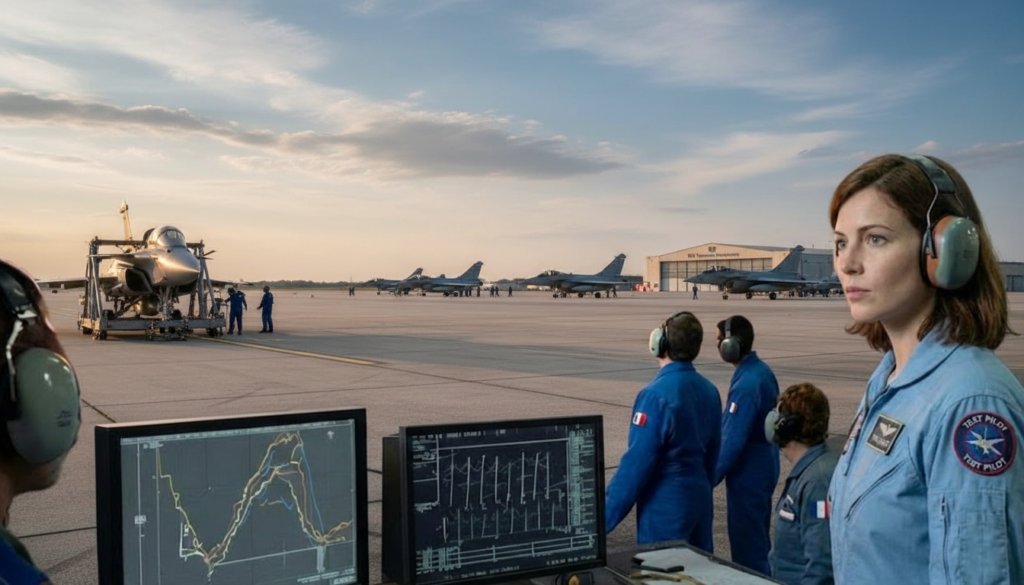
Europe can make engines for fighter jets.
But no one is scared. Instead, you see pure focus.
A young engineer moves closer to the glass and stares at the flame coming from the exhaust. “Listen,” she says. “You’re hearing the only fighter engine in Europe that we can make all by ourselves.”

Goodbye to Low Pension Payments: Retirement Support Rates Go Up in Early July 2026
She means France.
Goodbye to Old License Rules: Starting in February 2026, older drivers will have to follow new rules when they renew their licenses.
And she’s pointing out something that most people still don’t see.
France’s Unnoticed Air Power Advantage
From a distance, Europe looks strong: Airbus rules civil aviation, there are multinational fighter programs, budgets are shared, and cooperation is layered. But when you look at the engine, which is the most important part of a combat aircraft, the picture changes a lot. France is almost all by itself.
The M88 engine of the Rafale was designed and tested by Safran under constant DGA supervision. It is the only modern European fighter engine whose entire design, testing, and industrial control stay within the country’s borders. No licenses in the U.S. There are no required British, German, or Italian partners. France can make all the choices, from the digital model to the final turbine blade.
It’s not about pride. It’s about getting an advantage.
You won’t find a polished showroom when you walk into a DGA test hall. Instead, there are thick concrete walls stained by exhaust, old analog gauges next to ultra-high-resolution screens, and cardboard coffee cups on racks of sensors worth millions. In the middle is a silver cylinder that doesn’t look like much compared to the thunder it makes. It’s an M88, the Rafale’s living core.
Engineers purposely push the engine way beyond what a pilot would ever try during test campaigns. Changes in throttle that happen quickly, fake bird strikes, eating sand, and big swings in temperature. Cameras follow a single blade that is only a few centimeters long and spins at tens of thousands of revolutions per minute.
Engineering projects that change the way nature works often have effects that last a long time.
Why people often say to mix baking soda and hydrogen peroxide
The plant that people love for its smell and ability to keep mosquitoes away every spring
Why putting a bowl of salt water by the window works
A simple phrase that helps you politely say no to offers
The real benefits of having a cat in your home
A psychologist talks about the most important time in life.
New rules for trimming tall hedges that are close to property lines
If that blade breaks, it’s not just a part that is lost. It’s a plane. A pilot. A job to do. And the trustworthiness of a country.
This is when the DGA’s job becomes clear. It’s not just an agency that approves contracts. It is the state’s main defense analysis center. The DGA sets very high standards for the M88 and the future engine of the Franco-German SCAF fighter. They test prototypes over and over again until only the ones that really work are left.
Safran would still be a big engine maker even without DGA labs and test benches. But France wouldn’t be the only European country that could fully control the whole chain—design, materials, production, testing, certification, and operational feedback.
That small difference—who really owns the last bolt—becomes very important when things go wrong.
The French fighter engine’s microscopic precision
You need to zoom in to the millimeter level to understand what makes this ability so rare. It’s not just about raw thrust when making a fighter engine. It’s about tolerances that are so tight that a single hair would seem thick by comparison. The DGA and Safran work like watchmakers with flamethrowers.
A technician fine-tunes the cooling holes of a turbine blade in one workshop. The laser-drilled holes are so small that they are almost invisible. The metal was made at the atomic level to withstand very high temperatures. The DGA’s job is to set a clear limit on how hot “extreme” can be and to make sure that it is measured correctly.
In this case, accuracy is not an option. It’s why a pilot can turn on the full afterburner and know that the engine will work perfectly.
There are a lot of skilled engineers in Europe, but only a few countries have full control over the whole chain. For example, the EJ200 engine in the Eurofighter Typhoon is a project that involves people from many countries. Each country is in charge of certain modules, software parts, or areas of expertise. It’s strong, but no one capital controls it completely.
France took a different route. The government always put money into a national engine lineage, from the Mirage series to the Rafale, even when budgets were tight and critics said that working together would be cheaper. The DGA pushed for improvements in materials, aerodynamics, digital simulation, and testing infrastructure in the US, even though many people thought the facilities were too big for a mid-sized power.
 Goodbye Hair Dye for Grey Hair: What to Add to Your Conditioner for Natural Colour Revival
Goodbye to the Old P-Plate Rules: Big Changes to Driving Expected in 2026
Say goodbye to the old P-Plate rules; big changes are coming to driving in 2026.
To save money, most governments give up some control. Not France. That determination is what makes the country stand out in Europe today.
Recent shocks in the world of politics have suddenly made this long-term choice stand out.
When tensions rise, export controls get stricter and supply chains become political tools. This makes relying on foreign approvals a weakness. Because one important part or line of code comes from outside Europe, some European planes can’t be sold or upgraded without permission from the outside.
France talks directly with partners like India, Egypt, and Greece about the Rafale and its M88 engine. Without outside approval, the DGA can make changes, add new versions, and provide long-term support. France still works with other countries, but when it matters most, it keeps the keys to its engines.
That is what sovereignty means in 2026 in a quiet, technical way.
How the DGA Keeps Its Technological Edge
To keep this level of skill, you need to keep moving. The DGA runs a feedback loop that connects labs, test centers, and operational units all the time. Rafale squadrons that fly in the desert send back information about engine wear. DGA analysis teams use that information to improve test protocols, which can mean making a small change to the software or adding a new protective coating.
The cycle goes on and on. The DGA keeps track of every failure, micro-crack, and strange thing that happens. Safran might suggest a new alloy or a part made with 3D printing to make things work better. The DGA responds by putting things through the worst possible conditions to find out where and how they break.
The goal is simple: no surprises at 40,000 feet.
From the outside, this process may seem strict. Engineers talk about it in different ways from the inside. Many people remember late-night tests when data suddenly spikes and everyone waits in silence as the systems struggle. At those times, there are no shortcuts. The real world takes over.
States often make the same mistakes: they rely too much on foreign partners, don’t pay enough attention to boring test infrastructure, and let rare skills fade away without passing them on. The DGA works hard to stay away from these problems. It pays for little-known doctoral research on high-temperature fatigue and advanced alloys, and it keeps databases of test results that are older than many of its interns.
It looks slow from a distance. It’s the only way to keep such a complicated craft safe up close.
An engineer from the DGA says, “People see the Rafale engine as a product.” “In truth, it’s a living ecosystem of skills. If you don’t keep it up for five years, you won’t be able to build one anymore. You’re just a country that can buy one.
The DGA sets future engine requirements based on what the Air and Space Force needs.
Safran turns those needs into plans for designs and production.
Operational units give real-world feedback to improve standards.
Test centers break engines so that pilots never have to.
Research labs are working on the next big things that will make things more efficient, heat-resistant, and stealthy.
A Quiet Monopoly That Poses a Threat to Europe
Once you know how a fighter engine works, the industrial map of Europe changes. France is the only country that can still design, build, and certify a modern fighter engine on its own. Others add to and improve things, but not with the same level of control over the government.
This situation makes things hard to understand. Should Europe put everything into a few big programs and accept new dependencies? Is it worth it for each country to keep some of its independence? Or is the French model—a long-term national investment backed by a strong state actor like the DGA—a good example to follow?
There aren’t any easy answers. It is clear that this technical detail will have a big effect on future combat systems, the freedom to export, and political decisions.
The father leaves his money evenly to his two daughters and son in his will. The wife says this isn’t fair because of the difference in wealth.
There is a quiet message in the thunder of the Rafale’s engine when it flies over Paris during the 14 July parade. It talks about a country that made the choice decades ago to understand every turning blade and never let that knowledge go.